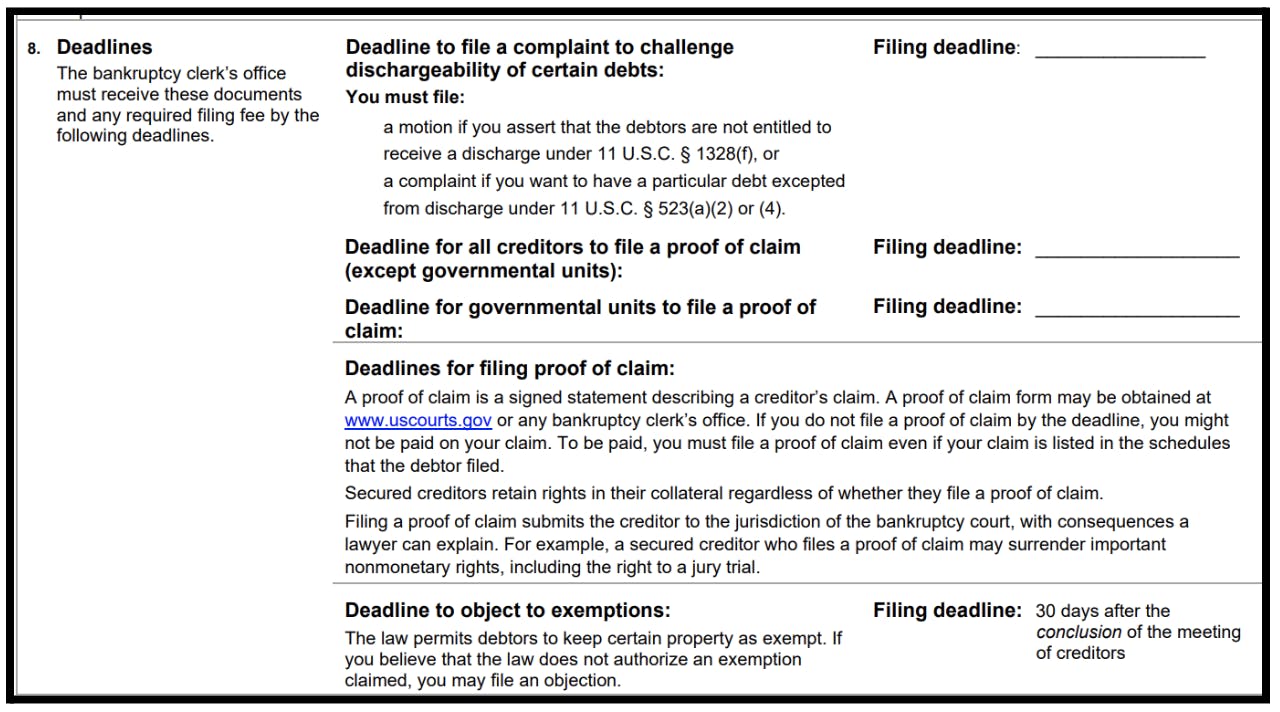
Filing a bankruptcy proof of claim is one of the most important steps a creditor can take to protect its financial interests when a borrower files for bankruptcy. When a debtor files, it initiates a legal proceeding governed by the United States Bankruptcy Code (Title 11, U.S.C.) and the Federal Rules of Bankruptcy Procedure, under which creditors must submit their claims to the court to participate in any distribution of the debtor's assets. Miss the deadline, omit a required document, or use the wrong form, and you risk losing your right to payment entirely.
This guide walks loan servicers, lenders, and other creditors through every step of the process, from identifying the deadline to filing the completed form, with direct references to the Bankruptcy Code and Federal Rules of Bankruptcy Procedure.
What Is a Bankruptcy Proof of Claim?
A proof of claim (POC) is a formal document filed with the bankruptcy court that declares the amount a creditor is owed and asserts the creditor's right to receive payment from the debtor's estate. Under Bankruptcy Code § 101(5), a "claim" is broadly defined as:
(A) a right to payment, whether or not reduced to judgment, liquidated, unliquidated, fixed, contingent, matured, unmatured, disputed, undisputed, legal, equitable, secured or unsecured; or (B) a right to an equitable remedy for breach of performance if such breach gives rise to a right to payment, whether or not such right to an equitable remedy is reduced to judgment, fixed, contingent, matured, unmatured, disputed, undisputed, legal, equitable, secured or unsecured.
In practice, this means nearly any legitimate debt, including mortgage balances, installment loans, auto loans, credit lines, credit obligations, fee arrearages, and many more debt types, qualifies as a provable claim.
Should You File a Proof of Claim?
The right answer depends on the chapter, the type of the claim, and the notices and orders entered in the case. Only filed claims are eligible for payment from a bankruptcy estate. Many debts are discharged in bankruptcy, meaning this may be your only opportunity to recover what you're owed.
In Chapter 7 no-asset cases, the initial notice may instruct creditors not to file claims because no distribution is expected. If the trustee later determines that assets may be available, the clerk will give creditors notice of a deadline to file claims. For a small unsecured claim in a no-asset case, weigh the cost of filing against what you realistically expect to recover. For a large secured claim, filing is almost always the right move.
Even when filing is not technically required, the creditor should evaluate whether filing is advisable to correct information, identify the proper notice or payment address, preserve voting and distribution rights, or address other case-specific concerns.
In Chapters 12 and 13, under Bankruptcy Rule 3002(a), a creditor generally must file a proof of claim for its claim to be allowed. The process is usually straightforward, and courts are designed to make it easy to declare what you're owed. If you have unusual strategic concerns, such as large balances or potential counterclaims, consult bankruptcy counsel before the deadline passes.